Saturday, November 29, 2014

GWTW: all you could ever want to know

When I was in Austin several days ago for a very important event, I managed to squeeze in a little time to visit the Harry Ransom Center on the UT campus. Long-time readers will remember an earlier visit here in 2013, but they are always mounting wonderful new exhibits and the current special one is not to be missed.


These mug-shot-looking pix are mug-shots of a sort: make-up stills for one of the most famous American movies ever made. GWTW=Gone with the Wind.

Since I was busy with other matters on this visit, I didn't have too much time to study the exhibit in detail, but it will be there for a while yet, and something tells me I'll probably be making some more trips to Austin before it leaves.

What's really great about this exhibition is that all the materials in it are from the Center's own holdings. They have an astounding collection of American literature and cinema manuscripts, documents, and artifacts. And what they don't have about GWTW just isn't worth having.

The most striking items in the exhibition are the costumes (some actually restored originals) and I took the most pictures of them. The dress on the right is Scarlett's wedding gown (first wedding, to Charles Hamilton). Some of the other dresses in the exhibition are from even more memorable scenes in the movie...

the "scarlet woman" dress Rhett makes Scarlett wear to Melanie's party

my favorite: the dress made from "Miss Ellen's po'tieres"
Another set of highlights are the "concept paintings," sketches to guide the building of sets and the shooting of various scenes. Here's an especially handsome one, of Twelve Oaks, the day of the barbecue at the beginning of the movie:


But there was so much more to read and absorb at the exhibit; I hope one more visit will satisfy me, but it might not.

I primed myself for seeing this by re-reading the book (probably for the first time since high school...now that's a peculiar experience!). 

And, for telling the story, the book is very much superior to the movie, although there are certainly more cringe-worthy scenes in the book than in the film. Some of the most interesting exhibits were correspondence, newspaper clippings, and other artifacts dealing with the racial aspects of the story; the moviemakers did tone down a lot of the more objectionable scenes and language from the text. However, the book does have a lot to teach us about how we got to where we are today, racially-speaking, and it provides a rich vein of story and references for illuminating post-modern treatments (I'm looking forward to reading Ruth's Journey, a GWTW spinoff told from Mammy's perspective). 

The exhibit also has a fascinating set of correspondence between the Production Code people and David Selznick, the movie's producer...they had plenty to get their boxers in a twist about in this story! That was the only section I took the time to read in full, and it was a hoot!

But the movie was truly a cultural phenomenon, and the 1930s equivalent of a social media firestorm. The hullabaloo about who was going to play Scarlett, for example, was intense, and gets a good chunk of exhibition space.

I also enjoyed some little details (and am looking forward to seeing more next time). For example, notice the mis-spelling of Vivian Leigh's name on the label for the still at left. And the details of filming the massive burning of Atlanta sequence was really cool...pretty impressive stuff for those pre-CGI days.

Even if you haven't read the book (I'm assuming everyone in the civilized world has seen the movie!) you'll enjoy this exhibit if you find yourself with some spare time in Austin. For GWTW-geeks, it's a can't-miss experience! (If you can't make it to A-town, the museum provides this next-best-online exhibition.)

Monday, November 24, 2014

A new member of the human family (and ours!)

One of the blips on the population clock, as of last Thursday, is my beautiful granddaughter!


We're so happy for her, Super Mom and Super Dad, as well as ourselves. Grandparents!!! How cool is that?!


Wednesday, November 19, 2014

Finally, famously Monumental


Yes, I'm finishing up my series of Four Corners posts with the area's most famous scenery, that I've hinted at, perhaps rather clumsily, in some previous posts.

We finished up the day we got off the river, after our quick trip to the Goosenecks, with an excursion south for dinner, into Arizona and back to the Navajo Nation. Monument Valley Navajo Tribal Park is the home of the iconic rock features you see above, familiar from so many movies (I knew the ever-helpful Wikipedia would have a listing!).

As you might have gathered from some of my other photos, you can see these unmistakable landmarks for miles around. Here's a sampling of nearby scenery with MV in the distance...

peering over the horizon at Goosenecks State Park

a fellow tourist took this shot for us at Muley Point
...and here's a look from one of the many scenic pull-outs along the road, getting closer to John Ford country...


We didn't really plan it this way, but it turned out that we were at the Park's main lodge (aptly named The View) at an absolutely perfect time: sunset.


the blogger soaks up scenery from a favorite movie

view from The View's soup/salad station
The food was good, too! And the view of the fading sunset on those rocks more than made up for the fact that they don't serve wine, even with food, at any Navajo Nation establishment.

The lodge also has a nice gift shop, with some really gorgeous Navajo jewelry, pottery, and textiles that was lots of fun to ogle, even though buying anything (other than a few souvenirs) was 'way beyond our budget. The whole operation was really top-shelf, with lots of friendly and helpful young Navajo service people around.

The mix of tourists was also interesting. As we had found at Canyon de Chelly, and were to see at the other stops we made over the next few days, there are lots of Europeans drawn to the iconic wide-open spaces of the Four Corners. We're used to Spanish being the second-most common language you hear, but on this trip it was German!

It would be really sweet to spend a night or two here, but you have to plan very far ahead; they fill up regularly a year out. 


That will have to wait for a future trip, as will the guided driving trips that take you really close to those wonderful MV rocks.

What a wonderful part of our wonderful country this is! We thoroughly enjoyed our time here and hope to return some day and catch the many sites that we missed on this go-round.

Saturday, November 15, 2014

Differently monumental, part 1

I became quite interested in memorials (especially war memorials) before and during my time in London in 2008.

So I couldn't help but be reminded of these artificial structures when we visited a couple of particularly monumental sites in the Four Corners area. First up is a wonderful little drive not far from Mexican Hat, Utah: Valley of the Gods.


It's not completely a slam-dunk to drive through this area; the road isn't paved, and although it was in good shape for most of its 17 miles, there were a few rather exciting wash-outs that were somewhat challenging.

we were very proud of the way our little van performed on a less-than-perfect road
But the scenery was worth the chances we took with our low-clearance vehicle.

As I hope you'll agree, there was so much photogenicity in this small area, it was very hard to stop taking pictures! And hard to find adequate words to describe the scenery...so I will let the pictures do most of the talking...

this was our favorite set of features...

...but there were so many to choose from!

the distant scenery was as sweet as the close-ups


the [mostly nice] road


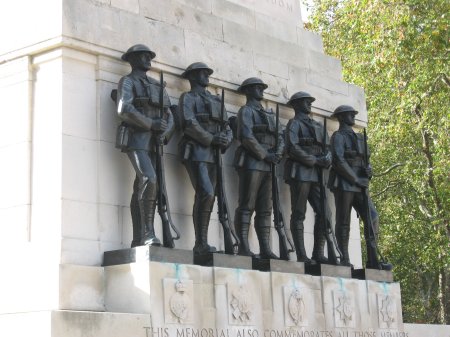
Here's final look at that favorite feature, which put me so in mind of one in London...separated at birth?

Valley of the Gods "guards"

Horse Guards memorial
Next time I'll finish up my posts about this wonderful trip with a look at some more famous Four Cornets monuments.

Thursday, November 13, 2014

A Texas interlude

It would take something pretty stupendous to distract me from finishing up my posts about our trip to the Four Corners.


And then, heavy rains last week provided one of the few excursions that could do this. We were able to paddle the upper Guadalupe for the first time in almost a year! This opportunity—both for boating and for blogging about it—simply could not be passed up.

It wasn't surprising that we had a bumper crop of paddlers show up on such a gorgeous day for the trip, starting at the Zoeller Lane bridge...


And we had a wonderful time. The water level, though paddle-able, wasn't high enough for many thrills, but there was a nice little chute after lunch. Here are Joline, and then Jon, making the transit look easy...


The river was beautiful and the water not too cold (a blessing for our few swimmers). But the trees were the real stars of the show. I couldn't stop taking pictures of the stately cypress, just starting to turn their autumn russet...

camera looking straight up

cypresses changed and changing

such a handsome lineup!

fall colorful
Then there are the usual great rockfaces one finds along the Guadalupe...costumed with fall vine foliage now, to make them extra photogenic:


And, in the Texas Hill Country, even the dead trees are beautiful!


Is there any reason these people wouldn't be happy to be here?! 

Saturday, November 8, 2014

Naturally beautiful bridges

Since we had just thoroughly enjoyed watching "The Roosevelts" on PBS before taking our trip out west, it was kind of cool to visit a national monument that crazy Teddy personally set aside.

Kachina Bridge
Natural Bridges National Monument is just a hop, skip, and a jump from our post-paddling base in Mexican Hat, Utah. So although we were disappointed that we couldn't make it to the more distant of Utah's many attractions, we were glad that this one was within reach.

The major attractions here (in addition to stargazing, which we were really disappointed not to be able to enjoy) are the three bridges carved out by the occasional streams that flow through White and Armstrong Canyons. The picture above is of the middle bridge of the three.

We only had time to hike at one of the bridges, the first one on the loop, Sipapu. Here's how it looks from the viewing ledge about half-way down the trail (which is where I stopped):


Henry hiked all the way down to the bottom, and got some great photos from that vantage point, like this one...


...while I got pictures of him 'way down there, in the "keyhole" made by the bridge (the red line will sort of show you where he is in this picture:


The main reason I didn't make the trek down was that I didn't want to have to climb back up the steep trail. But I also wanted to spend some more time on the fabulous Ledge Viewpoint...what an amazingly beautiful rock formation! Here's what it looks like from near the beginning of the trail...


...and here it is from a viewpoint near the end of the ledge. That tiny figure is Henry, just about to embark on his descent to the canyon floor...Thanks for providing the scale, dear!


I had a great time sitting up there, taking in the scenery, while he once again proved to be the more energetic member of our little partnership.

To give you an idea of how much hiking is involved here, this is a shot looking back up at the overlook, from the viewing ledge. You might be able to see tiny dots that are people up there, if you click on the image to enlarge it:


There was one more bridge to see in the park, Owachomo. It's the oldest of the three, and therefore the most slender (from more erosion):


This one's probably the most beautiful of the three, too, and Henry really wanted to hike down to it, but it was getting too late. We just didn't have enough time to do justice to this marvelous scenery!

In addition to the bridges, there are also archaeological sites in the park. Here's the most easily viewable, Horsecollar Ruin (the name is taken from the structure on the far right):


We weren't surprised to find evidence of early human habitation here, given what we learned on this trip about how advanced the cultures were that settled this region, and where they liked to build their little towns.

In addition to anthropology, you can also learn all kinds of geology, obviously, out here. For example, we wondered about the difference, if any, between arches and bridges. (Long-time readers might remember my trip a few years ago to Arches National Park, further north in Utah.) And the rangers at the Natural Bridges visitors' center were happy to oblige with this information.

Arches, astonishingly enough, are made by wind erosion, whereas bridges, like those you see here, were made by the—still amazing, but slightly more believable—process of water erosion. To paraphrase a popular blog, "IFL Geology!"